
Disclosure: Oleh Hebel founded Interface Report and runs Oleh Hebel & Co and Ship Index Grow, projects related to product design and AI education. No sponsor paid for or reviewed this article.
Direct answer: AAIF’s October 22 additions address different agent-system boundaries. Compatible formats help integration, while product teams still need to verify task outcomes, permissions and the user experience after migration.
The agent moves to another platform. Its files load. Its API responds. Then it handles the same customer request differently.
That is the portability problem worth testing. Moving an interface can remove integration work while leaving a harder question unresolved: does the product still make the decisions its users rely on? For a founder, the difference is between a credible exit plan and a migration that works only in a demo.
The Agentic AI Foundation's October 22, 2026 announcement provides a useful map. AAIF announced Agent Skills from Anthropic, Open Responses from OpenAI, OpenEnv from Hugging Face and OpenSandbox from Alibaba. They address different parts of an agent system. This article examines how to evaluate those boundaries; it does not report a new release today or claim that the projects have been tested together.
Four projects, four different contracts
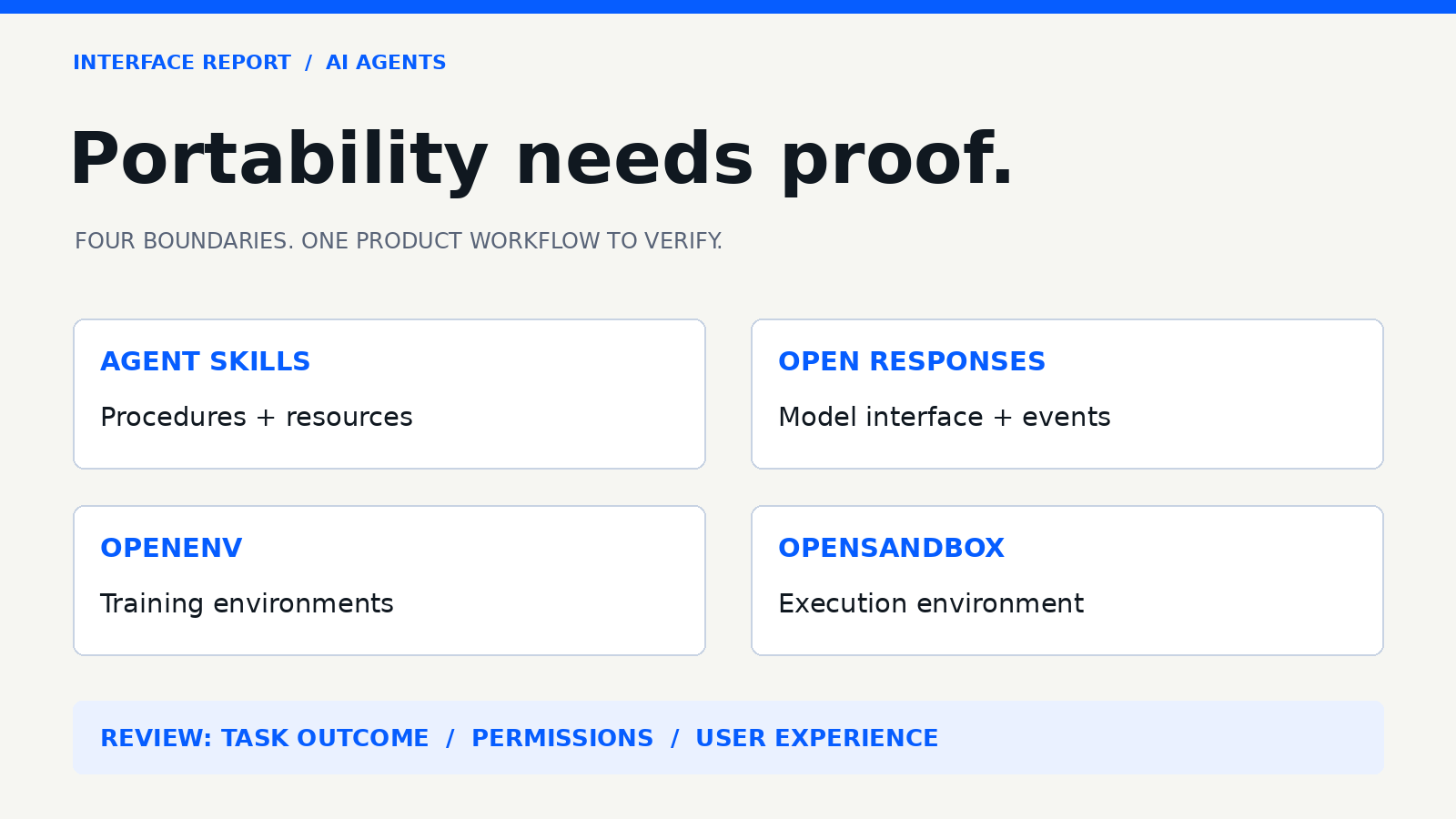
According to AAIF's announcement, the additions span reusable capabilities, model interfaces, training environments and execution infrastructure. Treating all four as a single interoperability feature would hide the most useful distinction: each makes a different part of the system easier to describe and exchange.
| Project | Boundary | What to check |
|---|---|---|
| Agent Skills | Procedures and resources | Does the new agent apply the right procedure? |
| Open Responses | Model API and events | Does the app interpret each state correctly? |
| OpenEnv | Training environments | Does the task represent the real workflow? |
| OpenSandbox | Execution environment | Are the required execution boundaries preserved? |
My recommendation is to inventory these contracts separately. A team might have a portable skill folder but still depend on one product's tool names, credentials or interface states. Recording those dependencies makes the migration plan more useful than a general claim that the stack supports open standards.
A portable procedure still needs its working conditions
The Agent Skills specification defines a directory with a required SKILL.md file and optional scripts, references and assets. It also provides a compatibility field for environment requirements. Its allowed-tools field is experimental, and the specification explicitly says support may vary between implementations.
Consider a hypothetical assistant that reads issue-tracker updates and drafts an email for customers. Its procedure might say to verify the release version, exclude internal comments and request approval before sending. Copying that procedure to another agent is only the start of a migration.
I would check whether the destination can find the same source records, distinguish internal notes and stop at the same approval boundary. If a named tool is missing, the team needs to establish what happens next. The product's expected response might be to ask for help or leave a draft; silently choosing a different action would require review.
These are proposed tests, not observed failures in Agent Skills. The point is to make the procedure's assumptions explicit enough that another implementation can be evaluated against them.
Separate API acceptance from product acceptance
Open Responses defines shared schemas and tooling for multi-provider model interfaces, including streaming events and tool invocation. Its acceptance-test page offers checks for specification compliance, covering areas such as basic responses, streaming and tool calling.
That gives a team a concrete starting point. Passing an interface check, however, answers a narrower question than whether a customer-facing workflow is acceptable. My proposed review would also examine the resulting decisions: which facts were used, whether uncertainty was surfaced and whether the requested action matched the user's authority.
For the customer-update assistant, a valid tool call could still target the wrong audience. A correctly formatted final response could still omit the release limitation that customers need to know. A migration scorecard should therefore preserve both kinds of evidence: protocol behavior and the quality of the completed task.
Test the environment you will actually operate
The OpenSandbox project documentation describes a unified sandbox API with Docker and Kubernetes execution options, plus network access controls. Those are infrastructure capabilities to configure and verify for the chosen deployment, rather than a blanket claim about every application that uses the project.
I would give the destination environment a small, explicit resource contract: required files, permitted network destinations, available tools and the lifetime of temporary work. Then test whether the assistant can complete its job within those conditions. A successful run with broader access would not establish that the intended production setup works.
The evaluation task matters too. In our hypothetical workflow, test records should include an internal comment that must stay internal, a release whose status is ambiguous and an audience the user cannot contact. These cases let the team inspect meaningful boundaries without inventing a large benchmark or confusing activity with useful work.
Make portability a result you can show
Start with a documented workflow and a small set of representative requests. Record the current system's inputs, permissions, expected decisions and external results. Change one boundary at a time, keeping the remaining conditions comparable, and inspect every regression before expanding the rollout.
For designers, include a review of what the person sees at each decision point. Does the new interface show the same proposal before approval? Does it explain when a required capability is unavailable? For engineers, keep the configuration and versions beside the results so the comparison can be reproduced.
AAIF's additions make the boundaries of agent infrastructure easier to discuss. The useful next step for a product team is a modest, demonstrable claim: this workflow, under these conditions, preserves the behavior our users need. That is a stronger portability promise than a list of supported formats.
Reporting note: Primary sources checked October 26, 2026. Vendor observations are attributed; examples and proposed evaluation criteria are editorial analysis. No hands-on testing is claimed.
Related reading
- Agent harness portability is becoming infrastructure
- Evals are the product spec AI teams forget to write
- Your AI agent may need fewer agents