
Disclosure: Oleh Hebel founded Interface Report and runs Oleh Hebel & Co and Ship Index Grow, projects related to product design and AI education. No sponsor paid for or reviewed this article.
Direct answer: An AI product needs a page that explains a real job, shows credible evidence and gives readers a clear next step. Google says its AI search features use the same SEO foundations as Search. Our recommendation: invest in a useful product story before buying a new optimization label.
Your team ships an agent that saves a messy workflow. The launch page calls it “the future of intelligent productivity.” A visitor still cannot tell whether it handles invoices, customer support or design reviews. The product may be impressive. Its story has failed the first decision.
For independent makers, this is a costly gap. A small team cannot afford to send every visitor into a sales call just to explain the basic use case. The public page has to carry that work. This article proposes a practical publishing framework for AI founders and designers; it does not report a new Google launch or measured traffic experiment.
AI search still starts with a working, useful page
Google’s guide to AI features and websites says that AI Overviews and AI Mode do not require special optimization or additional technical markup. Its guidance emphasizes accessible text, internal discovery, page experience and structured data consistent with visible content. Meeting the requirements does not guarantee inclusion.
The useful product implication is straightforward: the same description should make sense to a prospective customer, an editor and a search system. If your homepage describes an abstract category while your documentation describes a specific task, resolve that mismatch before commissioning another batch of articles.
Replace the category claim with a customer decision
Consider a hypothetical AI tool for independent design studios. “An autonomous creative workspace” sounds ambitious, but it gives a buyer little to evaluate. “Turn approved brand assets into a first draft of campaign layouts for designer review” describes an input, an output and a boundary. It also tells the wrong buyer to leave, which can be useful.
Write one sentence with four parts: who uses it, what they bring, what they receive and what they still control. Then check every major heading against that sentence. A product that requires review should not use a headline suggesting that human work has disappeared. Specificity makes the story more persuasive because the reader can picture using it.
Build a page around proof, limits and the next step
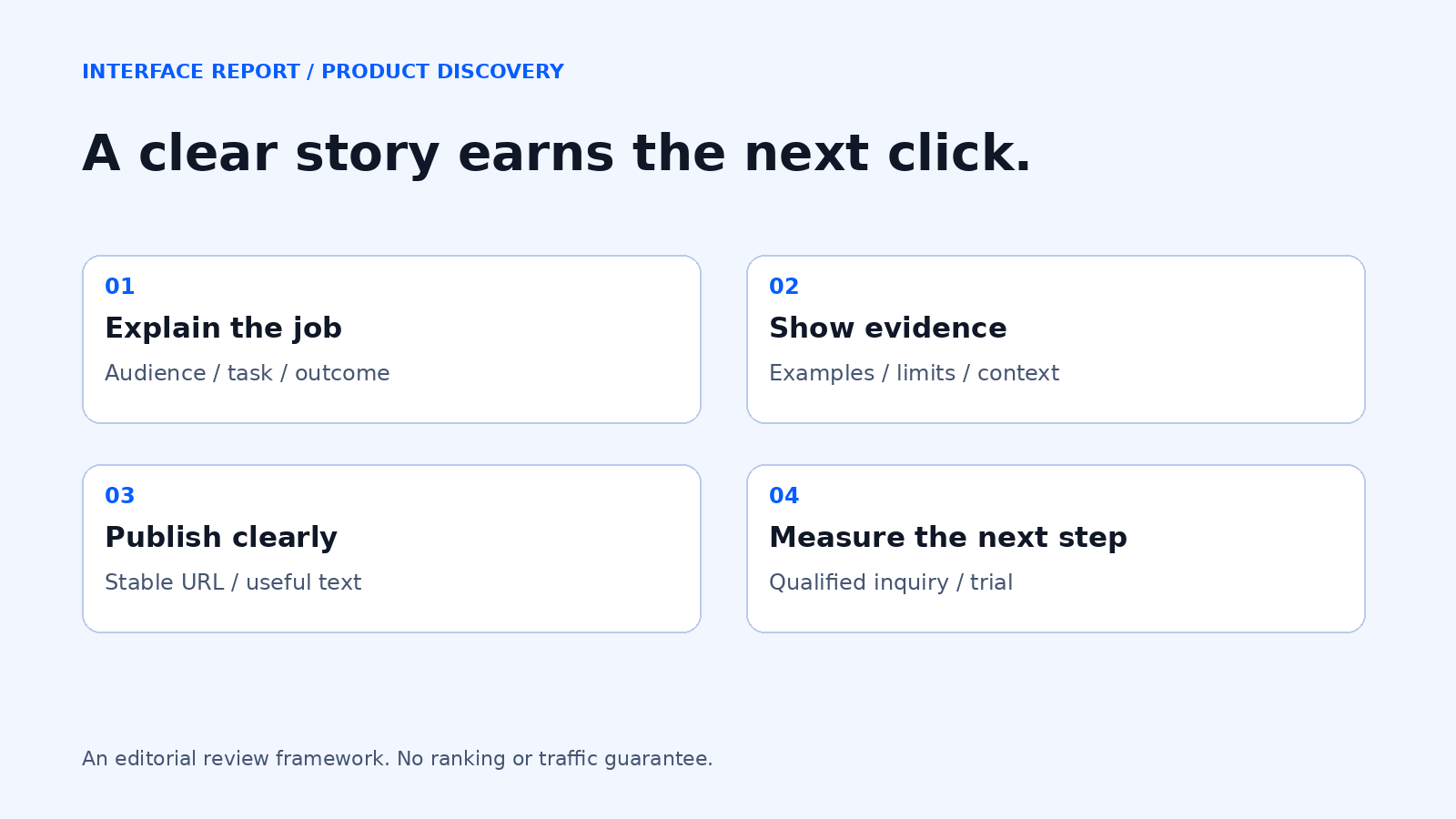
Our proposed page structure begins with a direct answer, followed by an example, a short explanation of the workflow, the relevant limitations and one primary action. A screenshot should support the explanation, not replace it. Describe what the reader should notice: a decision state, an output format or an approval control.
A useful demonstration can be modest. Show a sample input alongside its resulting draft, identify any manual editing and explain the test conditions. If you have not measured time savings, describe the steps that changed instead of inventing a percentage. A documented constraint often tells a serious buyer more than an unsupported superlative.
Google’s people-first content guidance asks whether a page offers original value, clear sourcing and enough information to help its intended reader. It also rejects the idea that Google has a preferred word count. For a founder, the editorial test is whether the page answers the questions a suitable customer needs to decide.
Give each intent a page that earns its place
Start with three different decisions: understanding the product, checking a particular use case and deciding whether to try it. Those decisions may deserve a homepage, a detailed workflow page and a pricing or application page. Link them with descriptive text so the journey is visible. Avoid publishing ten near-identical pages with different industry names unless the evidence and workflow actually differ.
For the hypothetical design tool, a workflow page could explain how an approved color palette becomes layout suggestions. The commercial page would explain the billing unit and what the trial includes. The two pages help each other because the reader can move from capability to commitment without guessing. This is an information design recommendation, not a ranking formula.
Use sponsored distribution with a clear job
A sponsored story can introduce a product through a publication’s subject focus. It should answer a question that matters to that publication’s readers and disclose the commercial relationship. Buying placement is a distribution decision; it does not establish independent approval of the product or guarantee search performance.
Before commissioning a feature, write down its intended destination. Will readers see a working demo, request a review or explore a relevant case study? Send them to the page that fulfills the promise made by the story. A general homepage with a different message can waste the attention you paid to obtain.
Measure the decision, then revise the story
Choose a meaningful action before publishing: a qualified inquiry, a completed trial setup or a demo request from the intended audience. Track the referring page and destination where your analytics setup permits it. Compare results over a stated period, and record other changes that could influence the outcome. Low conversion may reflect audience mismatch, product friction or an unclear offer rather than a shortage of keywords.
Technical eligibility remains a separate checkpoint. Google’s Search technical requirements identify crawler access, a successful HTTP response and indexable content as minimum conditions. Those checks tell you whether a page can participate; customer behavior tells you whether the story is doing its job.
A publishing brief you can use today
Choose one audience and one workflow. Collect a real example, write down what the product cannot do and select one next action. Publish the explanation on a stable URL with accurate authorship, dates and metadata. Connect it to relevant pages, verify that the links work and review the resulting inquiries. Improve the explanation when evidence changes.
The strongest hook is a useful promise the product can keep. Make that promise easy to understand, then give people enough proof to take the next step.
Sources and method
This original editorial framework draws on Google Search Central’s AI features guidance, helpful content guidance and technical requirements, checked October 30, 2026. The studio example is hypothetical. No product testing or ranking lift is claimed.