
Disclosure: In addition to founding Interface Report, the author also runs Oleh Hebel & Co and Ship Index Grow, projects related to AI product design and education. This article is independent editorial analysis with no sponsor involvement.
Direct answer: Claude Duet brings proactive work into a separate agent app. The product challenge is making every interruption and proposed action worth reviewing.
You did not open a chat. The agent opened a question in your day. That is the product shift behind Claude Duet: once software starts choosing when you should pay attention, the quality of its interruptions becomes part of the work you are buying.
Anthropic’s October 21 release notes confirm a research preview of Duet, a proactive agent. For product teams, the interesting question is what a person needs to see before trusting the next interruption. This article examines the published design; it is not a hands-on review.
What Claude Duet actually changes
According to Anthropic’s product page, Duet runs on Opus 5.5, brings across existing Claude memory, skills and connected apps, and works on its own cloud computer. It can prepare briefs, replies and business documents. Access begins through a waitlist for US Pro and Max subscribers; Team and Enterprise are excluded from the initial preview. Background activity shares the subscriber’s existing usage limits.
That combination creates a different relationship with a product. In a conventional chat, the user supplies both the question and the timing. A proactive agent has to choose which unfinished situation deserves to become a question at all. The interface is now making an editorial decision about your working day.
A founder does not need another beautifully written reminder that everything is important. They need a defensible reason why this invoice, customer reply or scheduling conflict should interrupt this hour. The product has to make that reason inspectable without turning the explanation into another task.
An agent needs to earn each interruption
Anthropic’s launch announcement says Duet checks connected accounts every few hours and asks before sending messages, making payments, signing documents or deleting anything. The company also acknowledges that it can misread urgency and cannot yet show users its browser. Those are company descriptions of a research preview, not independently verified performance guarantees.
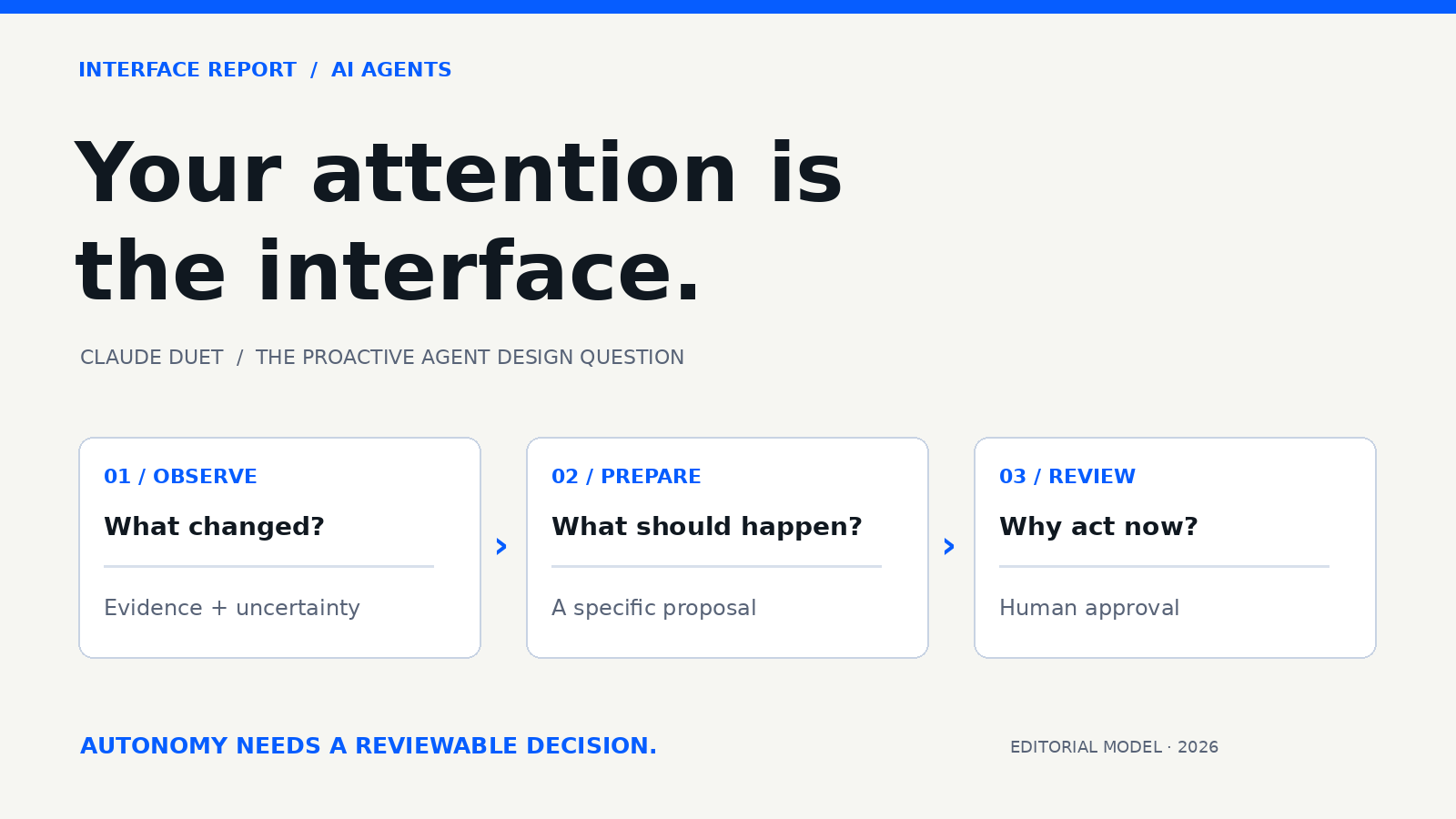
The design implication is larger than a notification setting. A useful interruption should answer four questions: what changed, which evidence supports it, what happens if the user waits, and what decision is needed now. Without those answers, an agent risks giving routine activity the appearance of an emergency.
Consider a hypothetical invoice reminder. “This needs attention” gives the owner another inbox item to investigate. A better proposal would show the invoice, the last relevant customer response, a suggested next step and the precise consequence of approving it. If the payment status is uncertain, that uncertainty belongs beside the recommendation.
This is an interface recommendation, not a claim that Duet already provides that exact view. It is also a useful test for any team building proactive software: could the recipient disagree with the recommendation without first reopening every source application?
Approval has to preserve the decision
An approval button can be easy to build and hard to trust. If a person sees only a polished summary, they may be approving the agent’s interpretation rather than the actual action. The review surface should show the recipient, the account being used, the exact outgoing content and any attached material.
For a proposed customer email, I would make edits invalidate the previous approval whenever they change the recipient, attachments or substance. An approval should attach to a specific version. Otherwise, the product can quietly change the thing a person thought they had authorized.
This extends the question explored in our agent control-surface analysis: a person needs to understand both what the agent intends and what the system has actually done. “Prepared,” “approved” and “sent” should be distinct states with evidence behind them. A confident completion message is not a delivery receipt.
The quiet agent still spends something
Duet’s published usage model matters because unattended work can consume a scarce budget before a person returns to the app. The product page says background checks count against plan limits. It does not establish how much useful work any particular subscriber will obtain. Check the current preview terms before joining.
For builders, I would treat checking frequency as a product control alongside cost. A user should be able to decide which work deserves frequent checks, which can wait for a digest, and which should pause as the available allowance runs low. “Always available” should not imply that every connected service requires the same attention.
For an early pilot, measure the work produced per interruption and the effort needed to verify it. A morning brief that takes longer to audit than the original inbox has shifted the workload rather than reduced it. That is a proposed evaluation criterion, not a measured finding about Duet.
A practical pilot for a small team
Start with one narrow workflow, such as drafting follow-ups from a limited set of customer conversations. Define what the agent may inspect, what it may prepare and which action requires review. Use examples where the right answer is to wait, because silence can be a successful outcome.
Then introduce disagreements: two messages give different dates; a customer has already paid; a document contains instructions that conflict with the task. Ask whether the agent surfaces the conflict and whether the reviewer can find the underlying evidence. Our prompt-injection analysis explains why source content and authority need visible boundaries.
Record accepted proposals, rejected proposals, missed events and time spent checking the work. Avoid judging the pilot only by the number of tasks marked complete. Completion volume can reward unnecessary activity. A useful agent should also prevent avoidable work and respect a deliberate decision to do nothing.
The product is the judgment around the model
Claude Duet makes a timely product question concrete: how should software behave when it can begin useful work before a person asks? Anthropic has published an initial answer, with explicit preview limits. Whether that answer succeeds requires observation beyond an announcement.
For founders and designers, the immediate opportunity is to build better decisions around autonomy: clear evidence, reviewable actions, visible spending and understandable pauses. The strongest proactive interface will give a person fewer reasons to check on it while preserving their ability to intervene. That is a harder promise than generating another excellent answer. It is also a more valuable one.
Reporting note: Based on the primary sources linked below, checked October 22, 2026. Product behavior and availability are attributed to Anthropic. Analysis and hypothetical examples are editorial judgment. No hands-on access, sponsorship or affiliate arrangement is claimed.
Related reading
- The agent interface as a control surface
- Prompt injection is an interface problem
- Undo is the feature agent products still lack