
Disclosure: Oleh Hebel founded Interface Report and runs Oleh Hebel & Co and Ship Index Grow, projects related to product design and AI education. No sponsor paid for or reviewed this article.
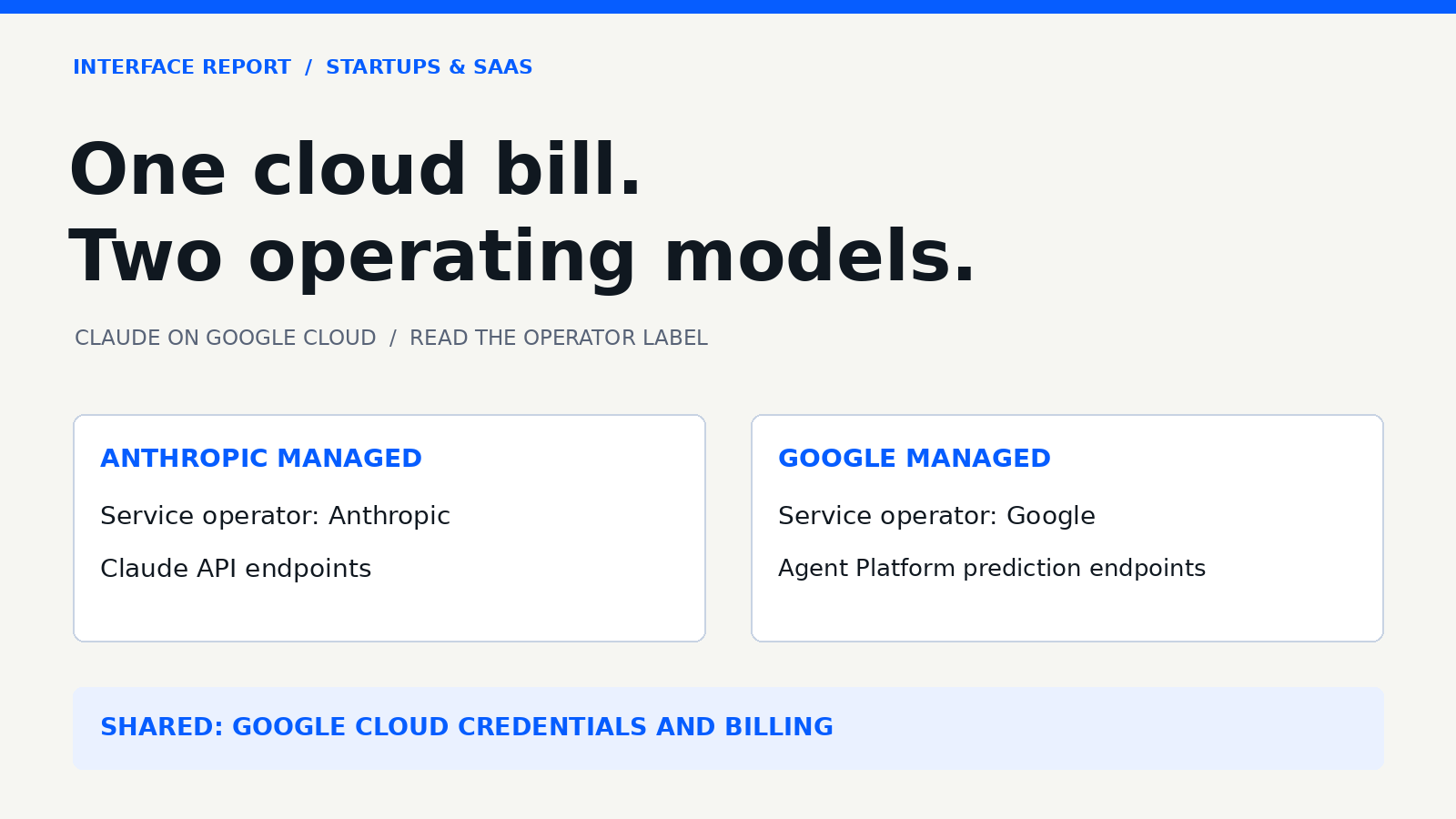
Direct answer: Claude on Google Cloud has Anthropic-managed and Google-managed routes. They share Google Cloud credentials and billing, but differ in service operator, API surface and feature support. Verify the selected route before moving a product workflow.
Your team sees a familiar cloud invoice. Your product is still making a new supplier decision.
That is the useful tension in Claude's latest Google Cloud expansion. A founder may see a simpler purchasing path, an engineer may see faster access to features, and a customer may assume the same data-handling arrangement they already approved. Those expectations need to meet before the first production request.
On October 22, 2026, Anthropic announced general availability of Claude Models on Google Cloud (Anthropic managed). It combines access to Claude Platform features with Google Cloud IAM credentials, billing and commitment retirement. Anthropic operates this service and is its data processor; a separate Google-managed offering remains available. The operator label is therefore part of the product decision, even when the bill arrives through an existing cloud relationship.
Start with the route your application actually uses
The official comparison distinguishes the offerings by their API surface, SDK client, access roles and operator. Both use Google Cloud credentials and appear on a Google Cloud bill. Sharing those two properties does not make their integrations interchangeable.
| Check | Anthropic managed | Google managed |
|---|---|---|
| Service operator | Anthropic | |
| SDK client | AnthropicGoogleCloud | AnthropicVertex |
| API surface | Claude API endpoints | Agent Platform prediction endpoints |
My recommendation is to put the selected route in the architecture record and the launch checklist. Record the client, request host, project and person responsible for the integration. A screenshot of a successful answer is insufficient evidence of which operating arrangement the application uses.
This matters beyond engineering. A sales team answering a buyer's infrastructure questionnaire needs a description that matches production. A designer explaining where an uploaded document goes needs the same understanding. The integration record should give both teams something more precise than a cloud logo.
Feature access can change the product promise
The announcement positions the Anthropic-managed route around native Claude Platform features and day-zero access to new features and betas. Availability still needs to be checked at the feature level. The Google-managed documentation, for example, lists the Files API and Claude Managed Agents among its unsupported features.
Consider a hypothetical SaaS product that lets customers upload research documents, revisit them later and run an agent against them. The product brief might treat that as one capability. The implementation could depend on several separate services: file storage, references to existing files, agent execution and a record of the resulting work.
Before promising that workflow on a new route, I would map each step to the specific capability it needs. If a required platform feature is unavailable, the team must evaluate an alternative implementation or change the scope. Reusing a model name in the settings screen cannot settle that question.
There is a corresponding design opportunity: make service-dependent capabilities explicit in the team's configuration model. The customer should encounter an accurate description of what their deployment supports, with a useful explanation when a capability is unavailable. Avoid discovering that boundary only after the customer has prepared a large upload.
Treat the organization as migration work
The Anthropic-managed setup guide says setup creates a new Anthropic organization for the Google Cloud project. An existing Anthropic organization cannot be converted into it. Workspaces, settings and stored resources do not simply carry over; the guide describes a cutover with independent organizations.
That is an important distinction for a small team expecting to change one credential and move on. My proposed migration inventory would include the resources the application expects to find, the configuration used to interpret them and the access required by each operator. Give every item a destination or an explicit decision to leave it behind.
For the document-workflow example, test an existing customer's return journey. Can they still find the right document? Does a saved link refer to the expected resource? Can the support team identify which organization produced an earlier result? These are proposed product checks, not failures observed in either service.
The same guide lists exceptions to feature support, including MCP tunnels, and explains that an existing zero-data-retention arrangement on another organization does not carry over. Teams should verify the current requirements for their actual workload. A broad launch headline should start that review rather than replace it.
Make the commercial promise reviewable
Anthropic's launch notice says customers with existing discounts should contact their account representative before starting, because discounts cannot be applied retroactively. That is a concrete reason to involve whoever owns the commercial arrangement before traffic moves.
I would attach a short commercial note to the pilot: who owns the bill, which arrangement the team expects to apply and how it will reconcile actual usage. Keep this separate from the product's performance evidence. A convenient purchasing path and an acceptable customer experience are different questions that both need answers.
For founders, the most useful first experiment is a representative workflow with a clear owner and a reversible traffic plan. Verify its feature requirements, resource migration and access behavior. Then review the resulting output, failure handling and usage record together. Expand only when that complete path supports the promise you intend to sell.
Claude's Google Cloud expansion offers another way to align platform access with an existing cloud relationship. The product work is making that choice legible: which service runs the request, which capabilities support the experience and which team can explain the result. Read the operator label before turning the integration into a customer promise.
Reporting note: Primary sources checked October 25, 2026. Vendor observations are attributed; examples and proposed evaluation criteria are editorial analysis. No hands-on testing is claimed.
Related reading
- AI pricing is becoming a product system
- Agent harness portability is becoming infrastructure
- The build-versus-orchestrate decision