
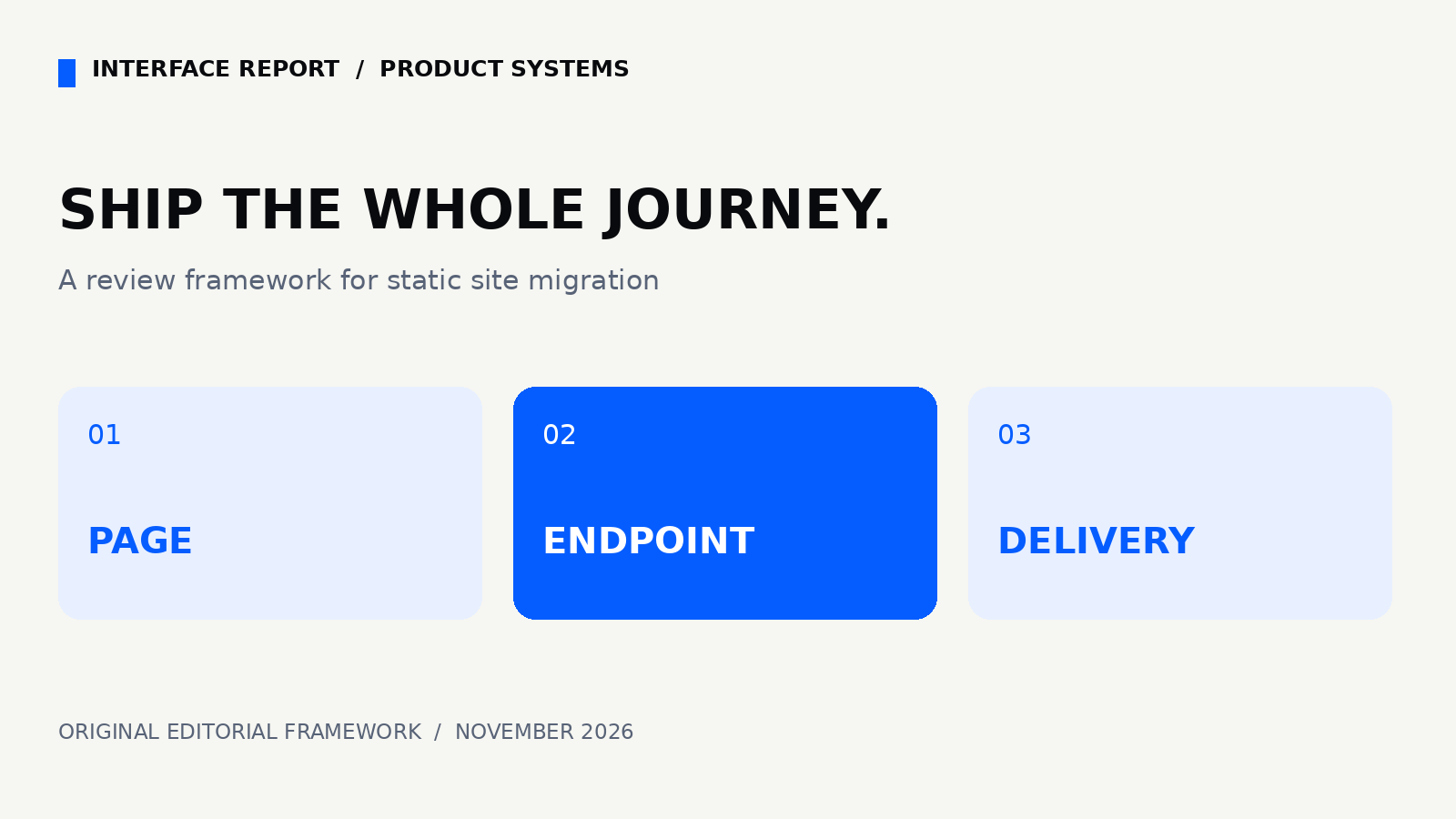
Original analysis and practical recommendations. Examples are hypothetical; no sponsor commissioned this article.
The page loads; the business journey still fails
A founder opens a newly migrated homepage. The logo looks right, the pages are fast and the deployment is green. A customer fills in the contact form, receives an optimistic message and never hears back. The migration moved the visible website while leaving its most valuable dependency behind. A release review must follow the action beyond the page.
This is an original product and engineering checklist for a hypothetical migration. It does not claim that a particular hosting provider loses inquiries or that any form service guarantees delivery. The goal is to make the boundary between static content and external processing visible enough to test before announcing a successful launch.
Know what your hosting actually runs
GitHub describes Pages as static hosting that publishes HTML, CSS and JavaScript from a repository, optionally after a build. That tells a team where to draw its architecture boundary. A server handler copied into the repository is still source code; the presence of that file does not prove a request can execute it on the deployed website.
Our recommendation is to inventory every action separately from the page that displays it. A contact form, newsletter, checkout link and file upload may use different services. Write down the destination, request method, expected response and ownership of each dependency. An inventory is useful even when the migration keeps the same domain and every navigation link appears unchanged.
Define what success really means
A success message is a product promise. Decide whether it means the processing service accepted a request, an application created a record or a recipient actually received a notification. These events are not interchangeable. The browser should display the strongest state supported by a real response, with language that accurately describes the remaining uncertainty.
For a hypothetical project inquiry, the service might confirm acceptance and return a reference. The page can show that reference and explain the next step. It should not claim that the founder read the message. A newsletter may require a separate confirmation step; show pending confirmation until that process is complete rather than implying immediate subscription.
Preserve a working path before replacing it
A managed form service can be a legitimate dependency for a static site. Review its configuration and documented client integration before declaring a public form identifier a leaked server secret. At the same time, credentials that authorize private mail, payments or administrative actions must stay outside public assets. Classify the value by its authority, not just by its name.
Replace the old submission path only when the new path is configured and verified. If the replacement is not ready, keep a known working route or provide an honest contact alternative. A migration that removes a functional integration to achieve architectural purity can create a worse customer experience than the dependency it intended to simplify.
Design failure before the happy-path screenshot
Test an unavailable endpoint, an unexpected response, invalid input and a slow connection. The form should preserve useful user input and explain how to retry. Re-enable controls after failure. Avoid clearing a long project description merely because the request timed out. A visitor should not have to reconstruct their thinking to contact you again.
A timeout creates uncertainty: the service may have accepted the message before the browser stopped waiting. If duplicate processing would matter, handle request identity in the receiving system. On the page, avoid promising that nothing happened unless you know it. Give the user a practical alternative with a clear label and enough context to continue.
Separate safe inspection from a real submission
Read-only checks can verify an endpoint’s availability contract, markup, required fields and error handling without sending a message to a person. An end-to-end delivery test creates an external side effect. Plan that test deliberately with the account owner, identify the destination and label the message so it is not confused with a customer inquiry.
Record what each check establishes. A valid HTTP response does not prove inbox delivery, and inbox delivery does not prove a later newsletter confirmation link works. The release record should name the tested stages and any stage still awaiting evidence. This makes support easier when the page looks correct but a downstream service changes behavior.
Keep discovery connected to the release
Update internal links and the regular sitemap when publishing real canonical pages. Google’s sitemap guidance recommends fully qualified URLs and accurate modification information. Treat a sitemap as a discovery aid rather than a conversion test. It cannot tell you whether a visitor’s inquiry reaches the business or whether a new page answers a useful question.
Retain article URLs and useful history through the migration. For translated content, link actual equivalents rather than inventing language routes that return the same page or an error. Crawl the resulting local links before release, then compare representative live pages with the intended output. Keep the content review and infrastructure review connected without confusing their evidence.
Release the journey, then maintain it
Create a compact release record: the deployed revision, important public URLs, form destinations, checks performed and unresolved dependencies. Verify the live domain after deployment. If the publishing workflow serves a release branch, confirm that the branch contains the intended changes. A successful check on an unrelated branch cannot establish production behavior.
Maintenance can begin with a free recurring read-only check of the homepage, sitemap and form configuration. Route failures to a review process rather than silently sending repeated test inquiries. The strongest modernization is often a clear operational contract: what the site promises, which service fulfills it and what a visitor can do when that service is unavailable.
Sources and method
Sources checked November 2, 2026. Editorial recommendations require validation in your own product. GitHub: What is GitHub Pages? · Google: Build and submit a sitemap
Related analysis: Streaming AI Needs a Status Contract